

Deck Permits in Hampden Township, PA: 7 Things to Know Before You Build
TL;DR — Deck Permits in Hampden Township, PA
- A building permit is required for any deck with a walking surface more than 30 inches above grade or for projects with a cost exceeding $500.
- Hampden Township enforces the 2018 International Residential Code (IRC) under Pennsylvania’s Uniform Construction Code (UCC).
- Don’t start building without a permit. Fines, stop-work orders, and forced removal are all on the table.
- You are responsible for scheduling all three required inspections (Footing, Framing and Final).
- When in doubt, call the Community Development Department at (717) 761-0119.
Have you always wanted to sit out back on a warm evening, cold drink in hand, watching your kids chase fireflies in the yard? Or maybe a grill sizzling with burgers or the fan lazily spinning overhead. That’s the deck life.
But, wait, you don’t have a deck. No problem, you can build one. But there is a problem—one does not simply build a deck, just like one does not simply walk into Mordor. You’ll have to draw up plans, purchase materials, and get a permit.
Permits aren’t glamorous—nobody’s posting their building permit application on Instagram (except this guy)—but skip it, and you could be staring down fines, forced tear-downs, or a deck you’re not legally allowed to use.
At Keystone Custom Decks, we don’t feel that it has to be complicated. We’ve helped homeowners across Central Pennsylvania navigate the permit process from start to finish, and this guide breaks down exactly what you need to know about deck permits in Hampden Township—without drowning you in code-speak.
Read on—because you’re one step closer to building a deck in Hampden Township in the heart of Cumberland County!







Do You Need a Permit to Build a Deck in Hampden Township?
You almost certainly do. The height of your deck and the scope of the project will determine the type of permit you’ll get.
If your deck’s walking surface is more than 30 inches above grade at any point, or if total project cost exceeds $500, you’ll definitely need to run through the full permit process—application, construction documents, inspections, and compliance with the PA Uniform Construction Code.
Even if your deck is 30 inches or less above grade, you’ll still need a zoning permit. A zoning permit ensures your deck meets setback and lot coverage requirements for your specific property, and it’s a separate process from the building code side.
Under Pennsylvania’s UCC, decks that are less than 30 inches above grade around the entire perimeter and have no roof or covering are exempt from IRC building code compliance. But “exempt from UCC” doesn’t mean “exempt from all permits.” You’ll still need zoning approval, so the safe move is to assume you need a permit and confirm with the Township before you dig a single footing.
How to Apply for a Deck Permit in Hampden Township (Step-by-Step)
The permit process can feel scattered when you’re piecing it together on your own, so here’s the whole thing laid out in order.
Step 1: Get the right forms
Start at the Hampden Township Community Development page. You’ll need the Residential Building Permit Application and the Township’s Deck Guide for reference on construction standards.
Step 2: Prepare your plans
Two (2) complete sets of construction documents must be submitted with your application. For a deck, that typically means:
- A dimensioned site plan showing the deck location on your property, distances to all property lines, easements, and any flood-prone areas
- Framing details: ledger size and connections, beam span, joist size and spacing, and a cross-section of the deck construction
- Stairway, guardrail, and handrail details (if applicable)
- Your total impervious coverage calculation (the application requires it)
You can submit your own drawings, but they must be scaled, detailed, and show property lines. Complex projects may require a registered design professional.
Step 3: Know who can pull the permit
A permit can only be issued to the property owner or a licensed contractor. If you’re using a contractor, they’ll need to provide their PA contractor registration number, a certificate of liability insurance naming Hampden Township as the certificate holder, and proof of workers’ comp coverage (or a notarized exemption).
Step 4: Submit and pay
Submit your application to the Community Development Department at 209 S. Sporting Hill Road, Mechanicsburg, PA 17050. The Township reviews applications on a first-come, first-served basis, and processing takes up to 15 business days for standard residential permits.
Step 5: Watch the calendar
Once your permit is issued, don’t let it gather dust. If you delay too long before starting work, the permit can lapse—so don’t pull a permit until you’re actually close to building. You have 180 days to start work or the permit lapses.
If your permit has lapsed, you’ll likely need to submit a new application or request an extension—call the Community Development Department at (717) 761-0119 or (717) 761-7267 to find out.
Zoning and Setbacks: Where Can the Deck Go?
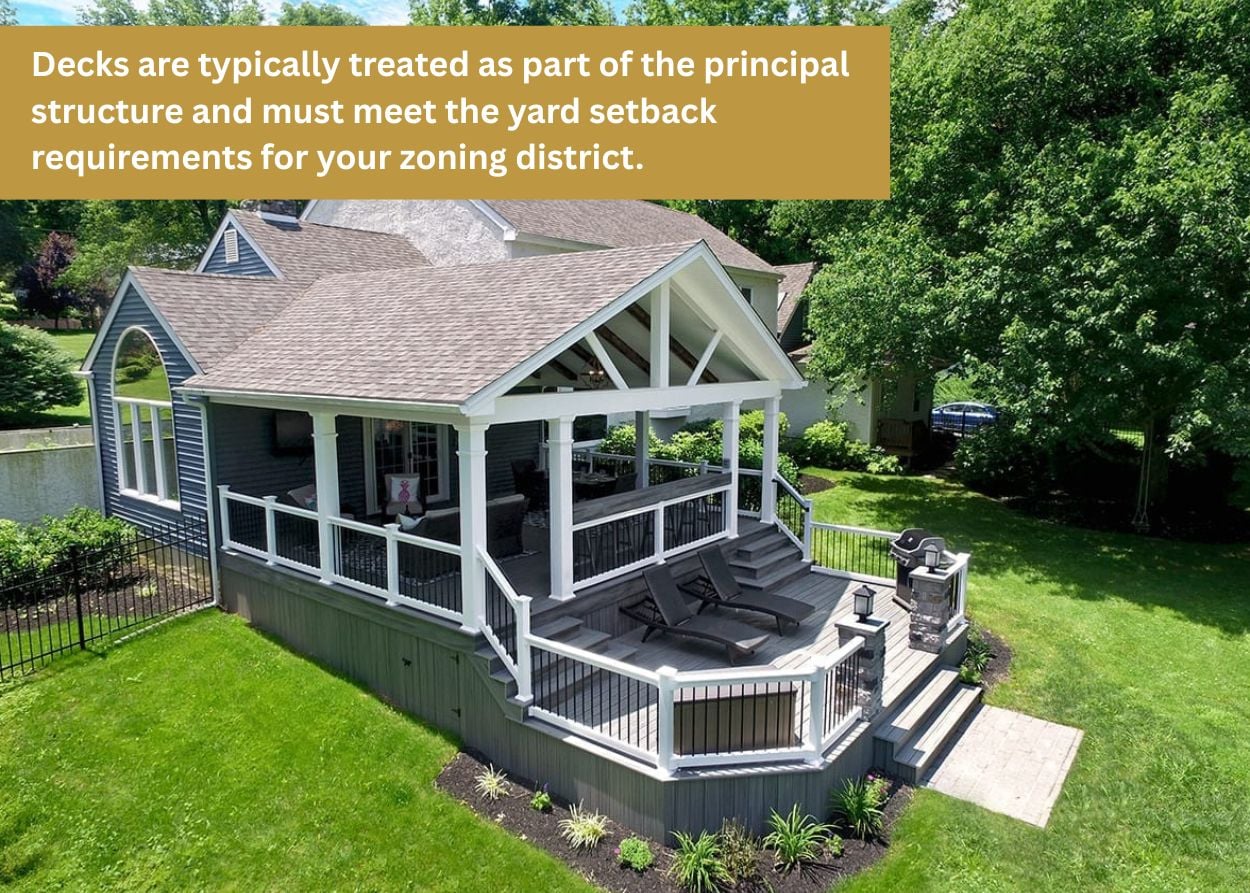
Just because you have a building permit, it doesn’t mean you can build anywhere on your lot. Decks are typically treated as part of the principal structure and must meet the yard setback requirements for your zoning district. Those setbacks vary across Hampden Township, so you’ll need to verify yours before drawing up plans. Typically, these setbacks may extend 10 ft into any required front or rear yard and 5 ft into the side yard.
In addition to your setbacks, your application must indicate whether your property is in a flood-prone area. You’ll also need to calculate your property’s total impervious coverage—that includes roofs, driveways, patios, decks, pools, and anything else water can’t soak through.
Finally, you’ll want to make sure you’re not digging into any buried lines, such as gas, sewer, or electrical, so call 811 before you dig.
To make sure your numbers are correct, contact the Community Development Department at (717) 761-0119 before you finalize your plans. They can tell you your zoning district, required setbacks, and whether any special conditions apply to your lot.
Deck Design & Code Requirements
Deck design requirements exist for a reason, because a deck failure isn’t a minor inconvenience. A deck failure could send someone to the hospital, or worse.
Hampden Township enforces the 2018 International Residential Code (IRC) as adopted by Pennsylvania’s UCC, effective February 14, 2022. Here’s what matters most for your deck project:
Footings
- Must extend below the frost line—Hampden Township requires a minimum of 32 inches deep, measured from the bottom of the footing to the surface.
- Must be concrete and sized to carry the deck’s load, typically rated for 40 pounds per square foot.
- Cannot put lateral pressure on your home’s foundation.
If your footings aren’t deep enough, your deck’s not going to be stable—and it’ll get worse over time.
Lumber & Fasteners
- All structural lumber must be #2 grade or better and pressure-treated to resist rot, decay, and insects.
- All connectors and fasteners must be corrosion-resistant—either hot-dipped galvanized or stainless steel. Non-corrosion-resistant hardware will not pass inspection.
- Nails must be threaded (ring-shank or spiral) to prevent popping as wood expands and contracts with changes in moisture.
The big takeaway: footings and connectors aren’t optional details. They’re what keep the deck standing.
Ledger Board Connections
- If your deck attaches to the house, use a 2x8 minimum ledger board with proper flashing to prevent water intrusion into your home’s structure.
- A minimum of 2 lateral load connectors within 24 inches of each end of the deck, each rated for at least 1,500 pounds. These stop the deck from pulling away from the house.
Guardrails & Stairs
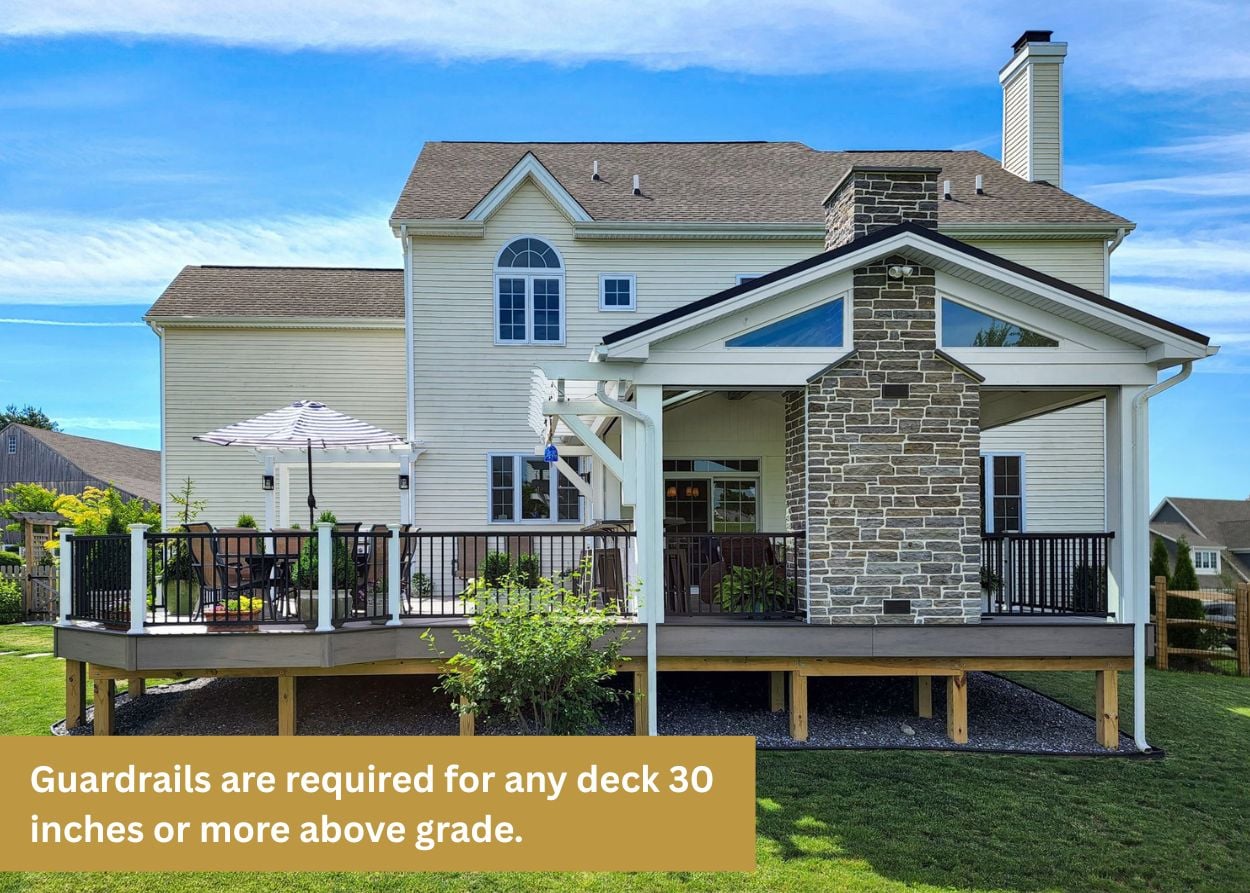
- Guardrails are required for any deck 30 inches or more above grade.
- Guardrail height: at least 36 inches from the deck surface.
- Balusters: no opening that allows a 4-inch sphere to pass through.
- Stair width: minimum 36 inches; max riser height 7¾ inches; min tread depth 10 inches.
- Handrails are required for any stair flight with 4 or more risers, mounted 34–38 inches above the nosing.
It’s a lot of detail and mind-numbing minutiae. It’s also exactly the kind of thing that Keystone Custom Decks handles every day, so you don’t have to memorize any of it.
3 Inspections You’ll Need to Pass
Permits aren’t just paperwork—they come with inspections. And you (the permit holder) are responsible for scheduling them. The Township isn’t going to show up on its own.
- Footing Inspection: This must be completed before you pour concrete. The inspector checks depth, size, and placement to make sure everything is where it’s supposed to be. Don’t pour a single yard of concrete until this is done, or you’re gonna have to start over.
- Framing Inspection: This takes place after the structural framing is complete—posts, beams, joists, ledger, lateral load devices—but before the decking boards or railings go on. This is where connections and hardware get verified, so everything needs to be visible and accessible. This checklist can come in handy.
- Final Inspection: Once the deck is 100% complete—decking, railings, stairs, the works—the final inspection confirms everything matches the approved plans. At that point, a Certificate of Occupancy is issued.
One important detail: your deck cannot be used until the final inspection is approved and that Certificate of Occupancy is in hand. Resist the temptation to fire up the grill early.
What Happens If You Build Without a Permit?
If you get caught starting work before a permit is issued, the consequences aren’t minor:
- Fines and penalties: The Township can issue citations, and each day of continued violation can be treated as a separate offense.
- Stop-work orders: Construction halts immediately, and the delays pile up fast.
- Forced removal or costly alterations: If your deck fails to meet code, you may have to tear it down entirely or rip up finished work so an inspector can verify what’s underneath. That’s as painful and expensive as it sounds.
- Insurance problems: Your homeowners' insurance may not cover damages caused by an unpermitted structure.
- Resale headaches: An unpermitted deck is a red flag during a home inspection and can tank a sale or force costly remediation at the worst possible time.
And it’s not just a slap on the wrist and fines. You’re pretty much going to be on the township’s naughty list forever.
Build the Deck—But Build It Right
You might be wondering whether building a deck is even worth the hassle, especially with all you’ve read. It absolutely is—most homeowners don’t struggle with building the deck. They struggle with the paperwork process. And that process is really just about knowing who to call, what to submit, and when to schedule an inspection.
Or, if you’d rather skip the paperwork headaches entirely, let Keystone Custom Decks take it from here. We work across Hampden Township and the surrounding Central PA area, and when you build with us, you get a local team that will:
- Produce clear, complete plans that match what Hampden Township expects
- Handle the permit application and all the paperwork
- Build to the 2018 IRC and all local design standards
- Schedule inspections at the right stages so nothing gets held up
We keep projects on the level. We don’t cut corners. And we don’t mess around. It’s our promise.
Contact us today and let us do the worrying for you!
Disclaimer
Any bureaucracy, although it may seem slow, can also be very fluid at the same time. While the information in this blog has been researched to the best of our knowledge, it’s important to note that:
- The information is gathered from publicly available online sources
- Permitting rules and requirements can change or vary by township
- It is always best for the homeowner to confirm directly with their local township or permitting office before starting construction