

Deck Permits in Middlesex Township, PA: A Cumberland County Homeowner’s Guide
TL;DR — Deck Permits in Middlesex Township, PA
- Right township first. PA has three; this is the Cumberland County one near Carlisle.
- Assume you need approval. Most decks need a building permit; almost all need zoning sign-off.
- New state code. PA adopted the 2021 building code on January 1, 2026, changing several deck rules.
- No online portal yet. Call the Township office at 717-249-4409.
- Confirm your setbacks. The Township is rewriting its zoning, so verify numbers before you design.
- Do not build until inspections are scheduled. Skipping the permit can cost far more than it saves.
A deck pays you back twice. It adds value to your home, and it gives the family room to rest and get some fresh air without leaving the yard.
Building one is not as simple as picking a spot and digging. Before the lumber arrives, there is a permit to sort out.
In Middlesex Township, that part comes with a few early snags. Three Pennsylvania townships share the name, one near Carlisle, one outside Pittsburgh, and another by the Ohio state line, so it’s easy to follow rules off the wrong website.
We are Keystone Outdoor Living, and we have built outdoor living spaces across Pennsylvania for more than 40 years. This guide covers what Middlesex Township in Cumberland County requires in plain language and flags where you need to call.
Read on—because you’re one step closer to building a deck in Middlesex Township in the heart of Cumberland County!
First, Confirm Which Middlesex Township You’re In
Did you know that Pennsylvania has not one, not two, but three Middlesex Townships? That’s because townships were created at the county level back in the day, long before a centralized state naming database existed that could have prevented duplication. There’s West Middlesex by the Ohio state line. The Butler County one is the one near Pittsburgh. The other, in Cumberland County near Carlisle, is the one we’re talking about here.
A search for “Middlesex Township deck permit” can easily land you on the wrong one.
So, the office we’re looking for is at 350 North Middlesex Road in Carlisle. The phone is 717-249-4409, and the site is middlesextwp.com. On a different address? Stop and double-check, because you probably hopped on to I-76 without realizing it.
Do You Need a Permit to Build a Deck in Middlesex Township?
Most certainly yes.
While Pennsylvania enforces the Uniform Construction Code (UCC) statewide, decks do get one exemption: an uncovered deck whose floor sits no more than 30 inches above the ground doesn’t need a building permit. You can see this in 34 Pa. Code 403.62.
Everything else needs one. If it’s taller than 30 inches, covered by a roof, or bolted to your house, you’ll need to pull a permit. Many townships require one for any attached deck regardless of height, since the ledger ties into the home.
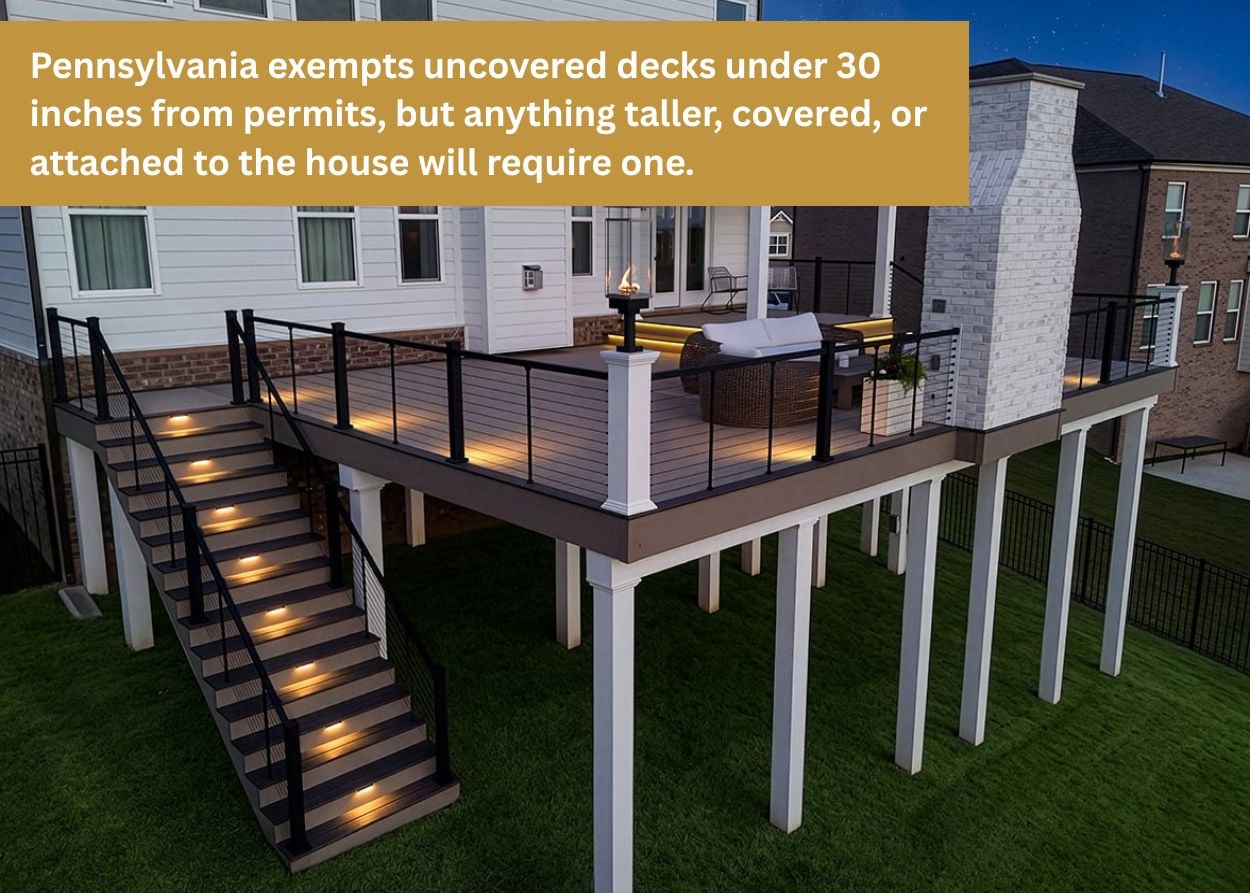
However, a low deck still needs zoning approval, since zoning controls where it can sit on your lot, and that’s a separate process.
Here is where your project likely lands:
| Your deck | Building permit (UCC)? | Zoning approval? |
| Uncovered, 30 inches or less above grade, and freestanding | Usually no | Usually still yes |
| More than 30 inches above grade at any point | Yes | Yes |
| Covered (a roof, porch roof, or pergola over it) | Yes | Yes |
| Attached to your house with a ledger board | Usually yes (confirm) | Yes |
How to Apply for a Deck Permit
Permits feel complicated because the steps are scattered.
Currently, Middlesex doesn’t have an online permitting process, but the Township’s permits page lists an online portal as coming soon. For now, call the office at 717-249-4409 (Monday through Friday, 8 am to 4 pm) or stop by 350 North Middlesex Road, Suite 1, in Carlisle.
Have these items ready: they’re the usual packet for a residential deck:
- A completed building permit application.
- A site or plot plan showing where the deck goes and how far it sits from each property line.
- Deck drawings: a framing plan and a cross-section showing footings, posts, beams, joists, how it attaches to the house, and the railing.
The permit goes to the owner or a licensed contractor. Some contractors even draw the plans in addition to pulling the permit.
On the cost of the permit, be skeptical of any flat number online: the UCC sets no statewide fee, and Middlesex does not post one. Deck permits across PA are based on a size-based formula and commonly run from $50 to $300; treat that as a rough planning figure and call the Township for the real one.
Once you submit a complete application, the code official has 15 business days to approve or deny it. Gaps in your paperwork can turn a two-week review into a two-month headache, so make sure it’s all there the first time.
You may need to deal with water, sewer, or on-lot septic, which goes through the Middlesex Township Municipal Authority, not the Township office, on a different number: 717-243-0674.
Zoning and Placement: Where the Deck Can Actually Go
A building permit says your deck is safe. Zoning allows it where you want it.
Setbacks, how far the deck must sit from each property line, depend on your zoning district. And Middlesex is mid-rewrite on its zoning. The ordinance on the books dates back to 2006, and a new draft was sent to the county for review in early 2025. Until it is adopted, the exact numbers can be a moving target.
We will not print a setback figure we cannot stand behind. Confirm your district and setbacks with the Township’s Zoning Officer at 717-249-4409 and ask whether any part of your lot sits in a floodplain, which adds a step before a permit is issued.
5 Code Details an Inspector Will Check
Pennsylvania’s UCC is based on on the 2021 International Residential Code, up from 2018. It changed several deck rules, so a builder quoting off old habits is a yellow flag.
Here is what an inspector looks at:
- Guards (railings). Any time the deck surface is more than 30 inches up, you’re going to need railings. The minimum height is 36 inches, and no gap is large enough for a 4-inch ball to pass through. That is what drives baluster spacing.
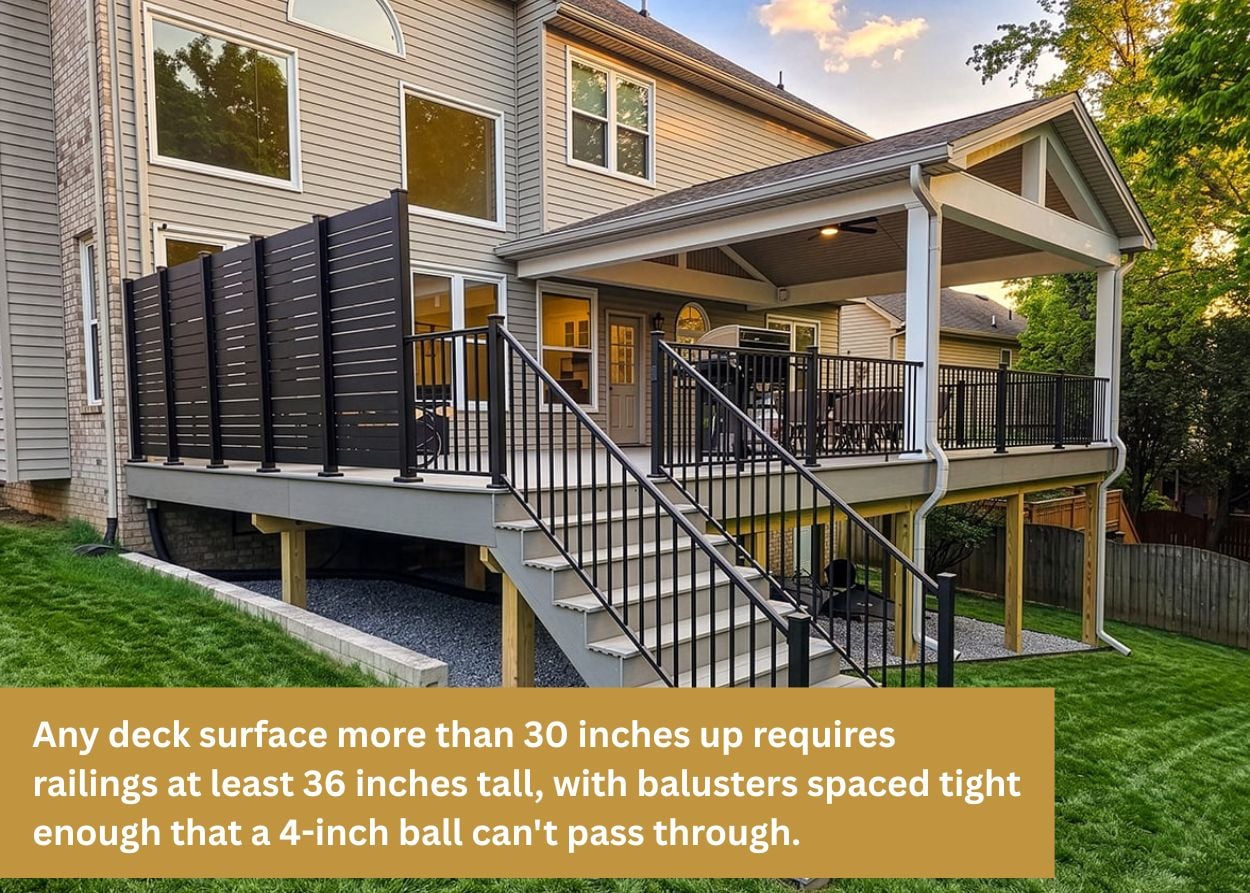
- Stairs. Risers must be no taller than 7¾ inches, and treads at least 10 inches deep. Any flight of four or more steps must have a handrail on one side, set 34 to 38 inches high.
- Footings. Concrete footings must extend below the frost line, so that freeze and thaw cycles cannot heave the deck. In Cumberland County, that is generally around 36 inches, but you should confirm that with your code official.
- Materials. Pressure-treated or naturally rot-resistant #2 grade lumber, paired with corrosion-resistant hardware like hot-dipped galvanized or stainless steel. Cheap fasteners corrode fast against treated wood, so connectors are not where you save money.
- Attachment. If the deck ties into your house, the ledger board needs flashing and bolting, plus lateral-load connectors that keep it from pulling away. Ledger failures are a leading cause of deck collapses, so this is not optional.
3 Inspections to Plan For
Permits come with inspections. For a typical deck, expect three:
- Footing inspection before any concrete is poured. The inspector checks hole depth and size.
- Framing inspection, after framing but before decking, covers it. Connections, the ledger, and bracing get checked here.
- Final inspection, once the deck, railings, and stairs are done.
You or your contractor schedules these, and the order can vary, so confirm it when you pull the permit. Do not cover up work before it is inspected, or you may have to uncover it later, or worse, tear the whole thing down and start over. And do not use the deck until it passes the final.
What Happens If You Skip the Permit
It’s tempting to skip it, but please do not.
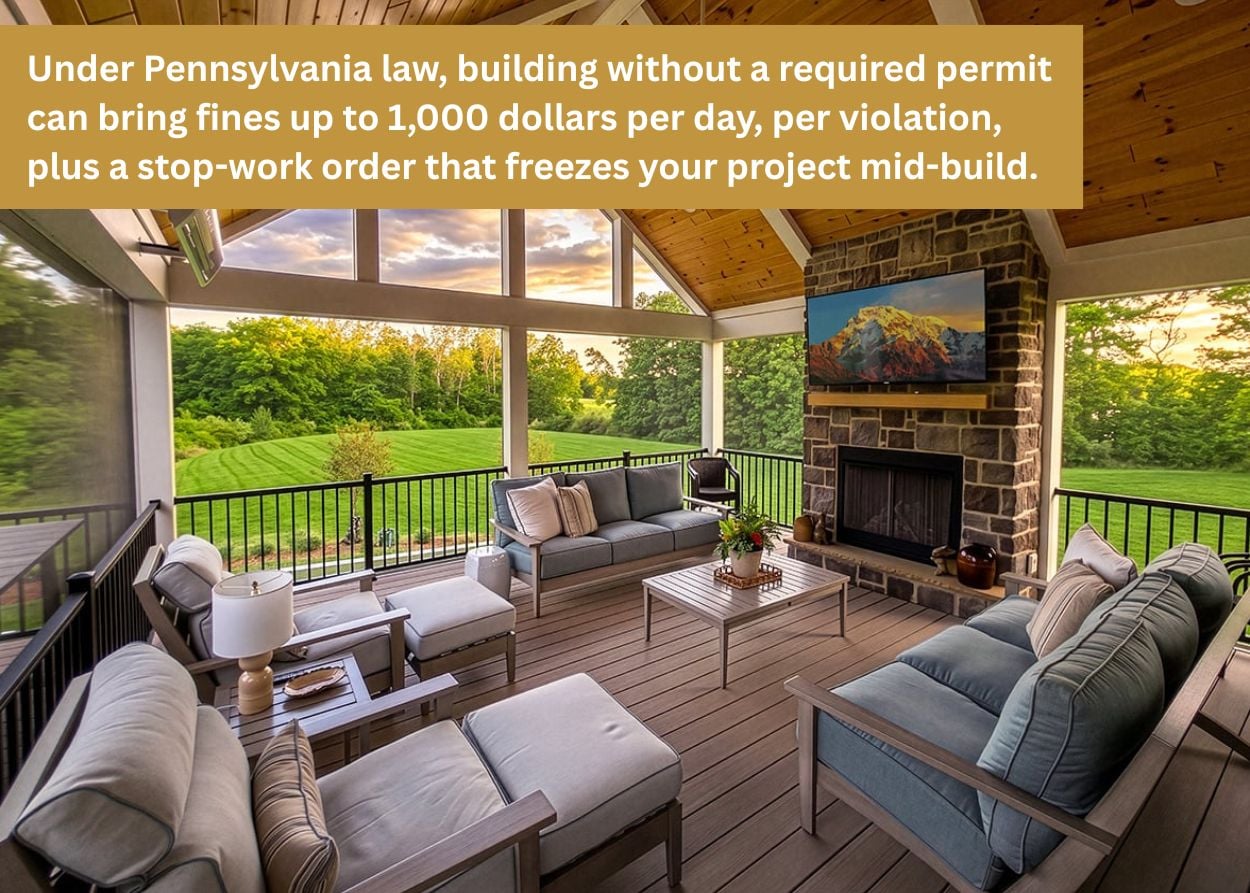
Under Pennsylvania law, building without a required permit can bring fines up to 1,000 dollars per day, per violation, plus a stop-work order that freezes your project mid-build.
The back end is worse:
- You may have to expose buried footings or pull up decking so an inspector can see underneath.
- An unpermitted deck can derail a home sale the moment it surfaces during a buyer’s inspection.
- Your homeowner’s insurance may not cover an unpermitted structure if someone gets hurt on it.
To cut corners just to save a couple hundred bucks and a few weeks? Not worth it. Just ask this guy.
Why a Local Builder Makes This Easier
It’s not that your typical homeowner can’t build their own deck. But it’s a lot of work, and it’s easy to get discouraged, especially when you get tied down in paperwork before the first board is even ordered. So some people skip the hassle and have a local contractor worry about it instead.
When you build with us, we:
- Confirm that you are dealing with the correct Middlesex Township and the correct offices.
- Prepare plans that match what the Township expects.
- Build to the current adopted code, now the 2021 IRC, and to local rules.
- Schedule inspections at the right stages to keep the project moving.
Build the Deck the Right Way
So you’re going to build a deck in Middlesex Township. Three things to remember: confirm you are in the Cumberland County township, sort out whether you need a building permit, zoning approval, or both, and don’t start until you know what the inspector needs to see.
Or skip the hassle and hand it to us. We will design your space, build it to current code, and carry the permit from application to final inspection. Schedule an estimate and let us do the worrying for you.
Or contact us so we can answer your questions before you commit. We’re here for you.
Disclaimer
Any bureaucracy, although it may seem slow, can also be very fluid. While the information in this blog has been researched to the best of our knowledge, it's important to note that:
- The information is gathered from publicly available online sources
- Permitting rules and requirements can change or vary by township
- It is always best for the homeowner to confirm directly with their local township or permitting office before starting construction.