

Deck Permits in Monroe Township, PA: A Cumberland County Homeowner’s Guide
TL;DR — Deck Permits in Monroe Township, PA
- Deck height decides your permit type. A walking surface 30 inches or less above grade needs a Zoning Permit. Anything over 30 inches needs a Building Permit under the Uniform Construction Code (UCC).
- You'll need a site plan and a completed application either way, plus proof of workers' compensation coverage or an exemption.
- Fees are based on construction cost, with a $400 minimum for deck-related building permits.
- Monroe Township enforces the 2021 International Residential Code, the version currently in effect statewide as of January 1, 2026.
- Setbacks depend on your zoning district. Decks generally follow the accessory structure setback rules, not the setback for your house.
- Skipping the permit is a real risk. Zoning violations can run $100 to $500 a day. Building code violations can run $300 to $1,000 a day, and the township can require you to expose or remove work that wasn't inspected.
There’s nothing like spending Friday evening with a burger on the grill and the Cumberland County hills turning gold behind the tree line. All you need to make this perfect is a deck.
A deck isn’t just a platform at the back of your house. It’s a dedicated space that offers a convenient escape from the rigors of daily life and a way to enjoy fresh air in a relaxing, private environment. It’s a retreat, an affirmation of the hard work you put in for your family; it’s a part of the American Dream. There's just one thing standing between you and that deck: the permit.
We get it. Permits aren't the fun part. But here at Keystone Custom Decks, we've walked enough homeowners through this process to know that a little clarity up front saves a lot of headaches later. Monroe Township in Cumberland County has its own rules for decks, and skipping them can cost you far more than the permit fee itself.
So let's break down exactly what it takes to build a deck in Monroe Township, from the first form to the final inspection.
Read on—because you’re one step closer to building a deck in Monroe Township in the heart of Cumberland County!
Do You Need a Permit to Build a Deck in Monroe Township?
The answer isn't complicated once you know where to look.
Monroe Township's zoning department’s webpage states that a Zoning Permit is required for decks less than 30 inches in height. For decks 30 inches or more in height, a Building Permit is required instead.
Why the split? Once a deck's walking surface climbs above 30 inches, a fall from it becomes a real safety concern, and that's where the Commonwealth's Uniform Construction Code takes over. But below that line, the township still wants to know what you're building and where, although the review is simpler.
Either way, something is required before any new construction or renovation begins. The owner of the home or structure is responsible for applying for and obtaining a permit and having the work inspected as it progresses, no exceptions.
How to Apply for a Deck Permit (Step by Step)
Here's what actually goes into the application, based on the township's own checklist.
Step 1: Get the application form. Conveniently, Monroe Township's Residential Zoning and Building Permit Application covers both zoning and building permits in a single form.
Step 2: Gather your paperwork. For every application, you'll need:
- A completed and signed application, including the estimated cost of construction
- A site plan showing the deck's location, dimensions, and distance from property lines
- A Certificate of Workers' Compensation Insurance, or a notarized exemption form
If your deck requires a full Building Permit (30 inches or higher), add three complete sets of plans showing foundation and footing details, framing sections, elevations, and railing and stair details where applicable.
Step 3: Understand the fees. Fees are based on the estimated construction cost, rounded up to the nearest $1,000:
- Zoning Permit (deck under 30"): $75 for the first $1,000 of work, plus $5 for every $1,000 after that
- Building Permit (deck 30" or higher): $120 for the first $1,000 of work, plus $12 for every $1,000 after that, with a $400 minimum fee for residential alterations, including decks
You can read more about the fees in the township's 2026 Fee Schedule and 2026 UCC Fee Schedule.
Step 4: Wait for review. Applications are reviewed on a first-come, first-served basis. Plans for one- and two-family dwellings are reviewed within 15 working days. That review time drops to just 5 business days if a licensed design professional certifies that the plans meet the UCC. That's a good reason to have an experienced local builder handle your paperwork.
Zoning, Placement, and Setback Rules
A permit allows you to build. Zoning tells you where.
Under Monroe Township's Zoning Ordinance, decks are an accessory structure, along with sheds and patios (the ordinance defines "Structure, Accessory" as including "decks, swimming pools, patios, antennas, tennis courts, garages, utility shed, etc."). That matters because accessory structures follow their own, generally more relaxed, setback rules rather than the setback required for your house.
The exact wording is "Porches, Porticos, patios, and decks shall be placed in accordance with the Accessory Use Side and Rear Yard setbacks specified in the applicable zoning district" (Monroe Township Zoning Ordinance, Section 4.02(C)4).
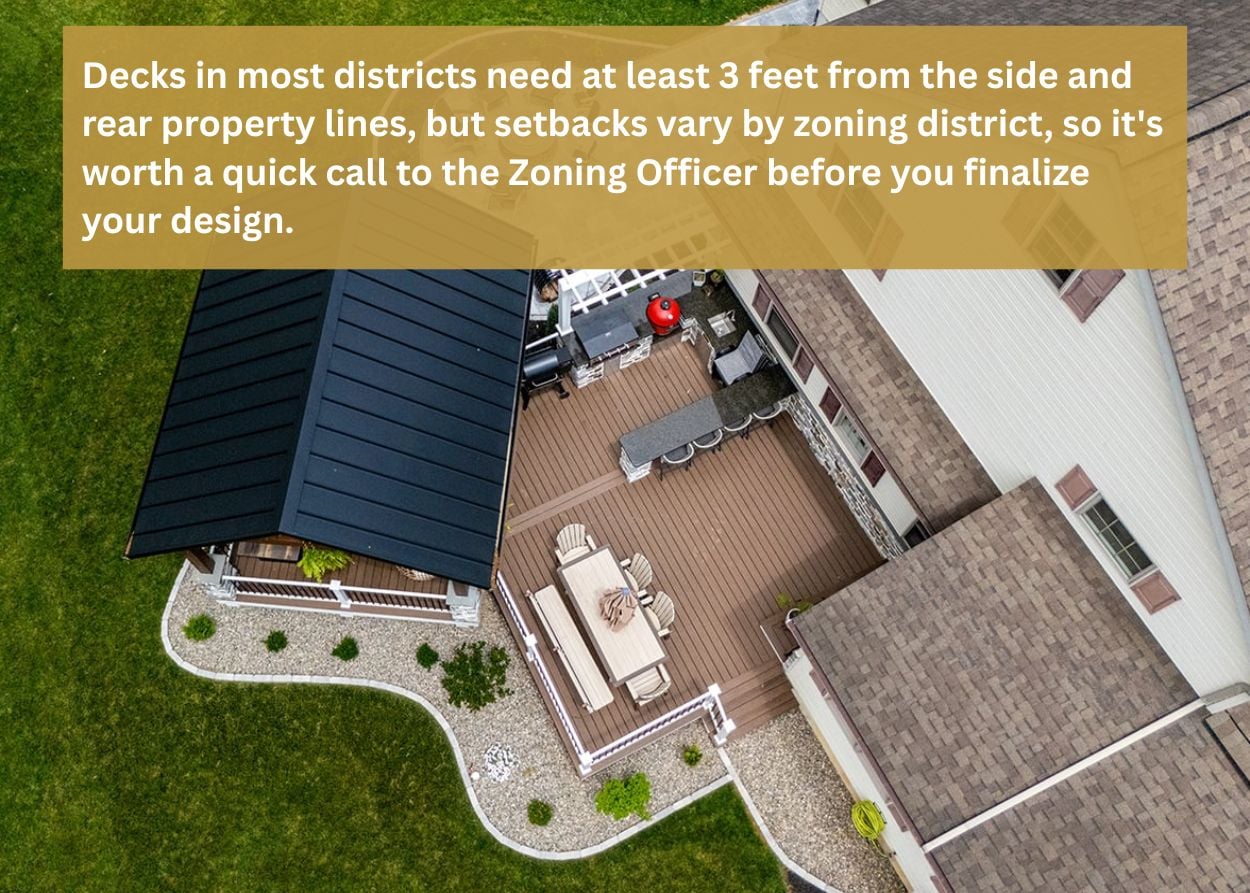
As an example, in the R1 Suburban Residential zone, accessory uses like decks generally aren't permitted in the front setback at all, need at least 3 feet from the side property line (6 feet combined for both sides), and at least 3 feet from the rear line, with a maximum height of 20 feet. Other zoning districts in the township set their own numbers, so don't assume your neighbor's setback applies to your lot. It's worth a quick call to the Zoning Officer to confirm your property's district before you finalize your design.
Design and Code Requirements: What Actually Keeps a Deck Standing
This is the part that sounds like fine print but is really the whole point of the permit.
Monroe Township has formally adopted Pennsylvania's Uniform Construction Code, which incorporates the Uniform Construction Code found in 34 Pa. Code Chapters 401 through 405 (Monroe Township Code § 150.20). The code in effect statewide is based on the 2021 International Codes, with the phase-in window for the prior 2018 edition having closed on July 1, 2026. That means any deck permitted in Monroe Township today is reviewed against the deck provisions in the 2021 International Residential Code (IRC), specifically the R507 section covering deck footings, beams, joists, and guards.
That section is where the real specificity lives, covering things like footing depth and bearing capacity, joist and beam spans, ledger board attachment to the house, and guard height and baluster spacing for any deck with a drop-off. Because these calculations depend on your deck's exact span, height, and local soil and snow load conditions, the Zoning Officer and Codes Enforcement Officer will confirm the specifics for your project when you submit plans.
Inspection Requirements
A permit isn't a one-and-done piece of paper. You’re also required to schedule inspections, and skipping them is one of the fastest ways to end up doing the work twice.
Because Monroe Township directly administers and enforces the Uniform Construction Code, the standard state inspection sequence applies. The Department of Labor and Industry's UCC inspection procedures call for a footing inspection at these build phases:
- Footing inspection: After the footing is dug, with rebar chairs and rods in place, but before the concrete is poured, and
- Framing inspection: After the framing work is complete, but before decking is installed.
- Final inspection: After the deck, railings, and stairs are complete. Note that the deck cannot be used until final inspection is completed.
Remember that you are responsible for scheduling the inspections. The bottom line is: don't pour concrete and don't call the deck finished until the right inspection has signed off on it.
What Happens If You Skip the Permit
Skipping the permit will result in major headaches.
Building without a permit in Monroe Township exposes you to real penalties. A zoning violation can carry a judgment of $100 to $500 per day, with each day of continued violation counted separately. A building code violation is treated as a summary offense, with a fine of $300 to $1,000 per offense, and, again, each day it continues is its own offense.
Beyond the fines, an unpermitted deck can force you to expose buried footings, tear out finished decking to prove the framing underneath meets code, or remove the whole structure if it can't be brought into compliance. And when you eventually sell your home, an unpermitted deck is exactly the kind of thing a home inspector flags. It’s not just a slap on the wrist: It’s an issue that won’t go away until after you sell your home.
It’s not that the township wants to hassle you in any way it can. Permits and inspections exist to ensure that whatever you build is done correctly, protecting you from injury and liability. Making you jump through these hoops is a way to incentivize you to take the build process and regulations seriously.
It’s not worth the risk. Just ask this guy.
Why Work With a Local Contractor
It’s a lot of paperwork for a project that's supposed to be about relaxing in your own backyard. That's exactly why homeowners bring in a contractor who already knows the process.
At Keystone Custom Decks, we've spent decades building decks throughout Southeastern and Central Pennsylvania, and we know how to prepare plans that meet Monroe Township's requirements on the first try. We handle the application, the plan details, and the inspection scheduling, so you're not stuck decoding zoning tables or IRC span charts on your own.
In addition to taking the hassle off your shoulders, we’ll help you design your deck, so you won’t just have a mere deck, but a beautiful space that you can enjoy every day, for years to come.
Contact us today to schedule a free consultation!
Disclaimer
Any bureaucracy, although it may seem slow, can also be very fluid. While the information in this blog has been researched to the best of our knowledge, it's important to note that:
- The information is gathered from publicly available online sources
- Permitting rules and requirements can change or vary by township
- It is always best for the homeowner to confirm directly with their local township or permitting office before starting construction.